
The Story & Collection of Dolmabahce Palace
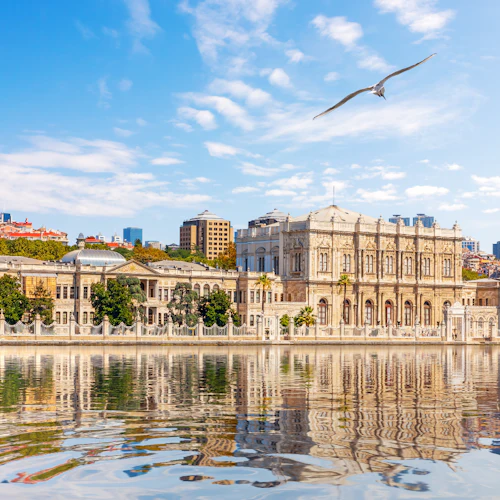
Sultan Abdülmecid I had the palace built between 1843 and 1853, to designs by Garabet Balyan, his son Nigoğayos Balyan and Evanis Kalfa of the Armenian Balyan family of architects. It replaced the old Topkapı Palace as the empire's main administrative centre for much of the period until 1922. After the founding of the Republic, Atatürk used it as a summer residence, and he died here on 10 November 1938; the clocks in his room are still stopped at the time of his death.
The palace has 285 rooms and 46 halls, and fourteen tonnes of gold were used to gild its ceilings. The Ceremonial Hall is lit by a giant crystal chandelier with 750 lamps weighing about four and a half tonnes, and the double horseshoe Crystal Staircase is made of Baccarat crystal, brass and mahogany. The Harem section consists of interconnected apartments for members of the imperial family.
Today the palace is a museum run by the Directorate of National Palaces.
Highlights
- The giant chandelier in the Ceremonial Hall
- The Crystal Staircase of Baccarat crystal
- Atatürk's room, with the clocks stopped
General Admission Ticket — Dolmabahce Palace
Book your official admission ticket online with guaranteed entry timeslot for Dolmabahce Palace. Skip the ticket desk line.
- Full access to the permanent collection & masterpieces
- Instant mobile barcode access at the turnstile
- Guaranteed reserved timeslot with no ticket line waiting
- Free cancellation up to 24 hours before your visit
- 100% verified official ticket
Top experiences & sights near Dolmabahce Palace
Instantly bookable via our partner Tiqets · mobile tickets · often free cancellation
Architecture & Halls of Dolmabahce Palace


Practical Visitor Info & Getting There
Tue – Sun: 09:00 – 17:00 · Mon: closed
Timeslot reservation recommended
Metro / Bus station nearby
Stop within walking distance

Yoshitoshi: Meester van de maan
Van Gogh Museum, Amsterdam

Monet: Painting Time
Musée de l'Orangerie, Paris

De Gaulle Before de Gaulle
Musée de l'Armée & Napoleon's Tomb, Paris

Picasso – Bacon: What It Feels Like to Be Human
Albertina Museum, Vienna